Where things stand
Emerald ash borer is a small metallic-green beetle from Asia whose larvae feed under the bark of ash trees, cutting off the flow of water and nutrients. It reached Tennessee in 2010 and Middle Tennessee in the summer of 2020; the City of Murfreesboro had already been removing declining ash from public property for years in anticipation. The beetle kills more than 99 percent of the untreated ash it reaches, and it has reached all of Rutherford County — the green ash planted as street trees in the 1990s subdivisions, the white ash in the older neighborhoods, the volunteer ash along every creek and fence line.
How to recognize it
- Crown dieback starting at the top — the tree thins from the top down over two or three years.
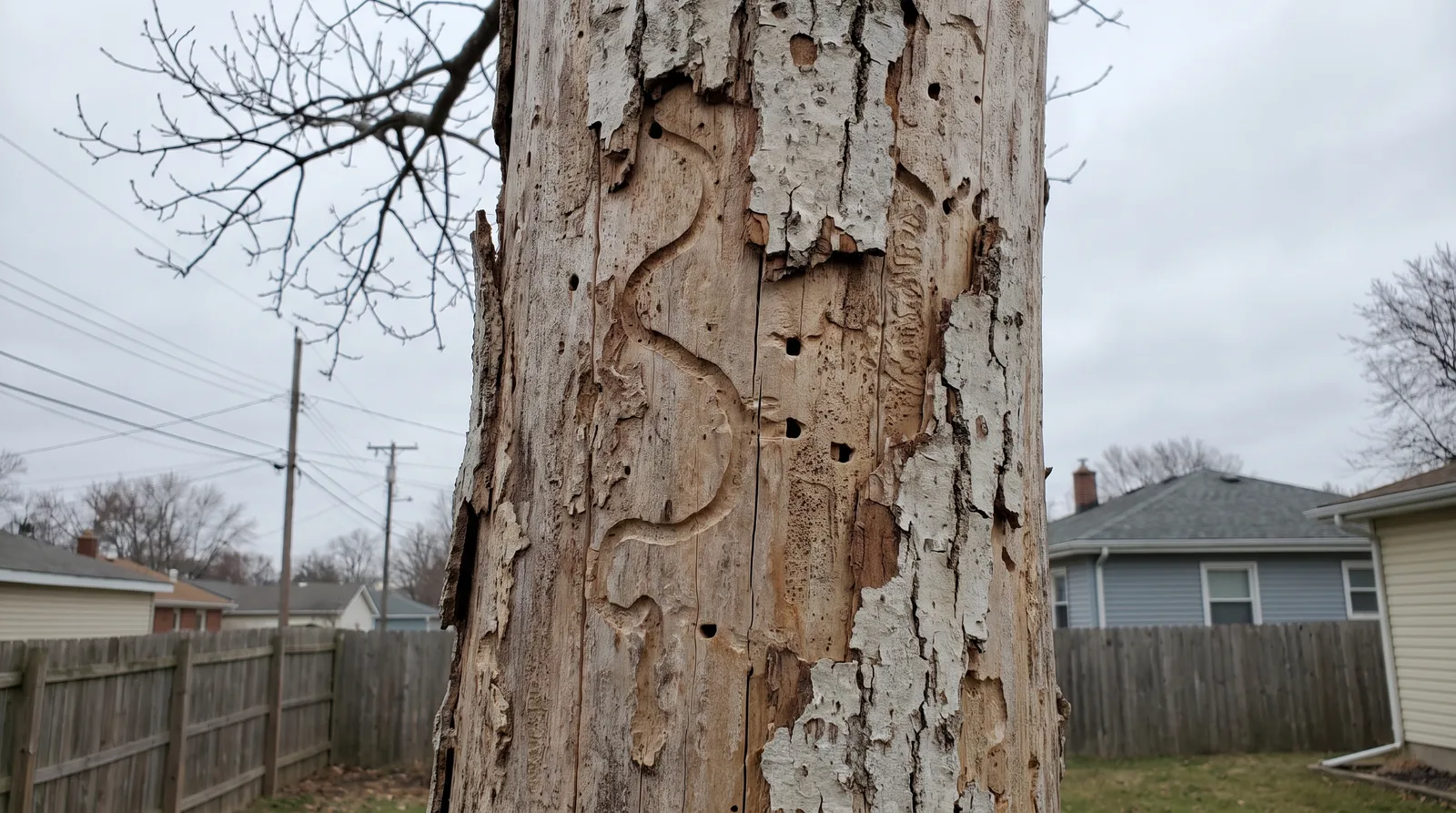
- Bark blonding — woodpeckers strip the outer bark hunting larvae, leaving pale patches on the trunk and big limbs.
- D-shaped exit holes, about an eighth of an inch across, where adult beetles chewed out.
- S-shaped galleries under bark that's peeled back.
- Epicormic sprouts — clusters of shoots from the trunk and base as the tree tries to survive.
- Bark splits over the galleries.
First, make sure it's an ash: opposite branching, compound leaves with five to nine leaflets, and a diamond-pattern ridged bark on mature trees. Plenty of "dying ash" calls we get turn out to be hackberries or elms with a different problem.
Treat or remove
If the ash is still healthy — more than two-thirds of its crown intact, no bark blonding — it can be protected with a trunk-injected insecticide applied every two years, for the rest of its life, at roughly $10 to $14 per inch of trunk diameter each time. For a big, well-placed ash that shades the house, that can be worth it. Below about half a crown the tree can no longer move enough insecticide to matter, and the answer is removal. Our arborist tells you which side of the line yours is on.
Why a dead ash gets expensive
Ash wood loses its strength quickly after the tree dies. Within a year or two limbs snap under a climber's weight and the trunk can shatter when cut, so a dead ash has to come down from a bucket truck or with a crane, in smaller and more careful pieces the worse it gets. Removing an ash the year it dies costs a fraction of removing it three years later, and a dead ash over a house, a driveway or a neighbor's fence is a liability you don't want to carry through another storm season.
What to replace it with
Something the borer can't eat and the soil suits: chinkapin oak, shumard oak, white oak, blackgum, yellowwood, or a bald cypress in a wet spot. Not another ash, and not a Bradford pear. Burn the ash wood locally if you keep it — moving ash firewood between counties is how the beetle spread across Tennessee in the first place.
Common questions
Are there any ash trees left in Murfreesboro?
Treated ones, and a scattering of trees the beetle hasn't finished yet. Untreated, essentially none will survive.
Is it too late to treat my ash?
If it's lost more than a third to half of its crown, yes. If it still looks mostly healthy, no — but the clock is running, and treatment has to continue every two years for the life of the tree.
Does the city remove dead ash on my street?
If the tree is in the public right-of-way, it's the city's tree and the city's job; report it to the Urban Environmental Department. A dead ash on your lot is yours.
How much does dead-ash removal cost?
$400 to $900 for a small one in the open, $900 to $2,200 for a medium one near a structure, $2,200 to $5,500 for a large one over a house with a crane. Rows of dead street ash are priced per tree with one setup.
Can I leave a dead ash standing in the back corner?
If nothing is under it and nobody walks there, a dead tree is habitat. Over a fence, a shed, a play set or the neighbor's yard, it's a hazard that only gets more dangerous.
Related: Ash tree removal · Crane tree removal · Commercial & HOA tree service · Cost guide