What a hackberry is
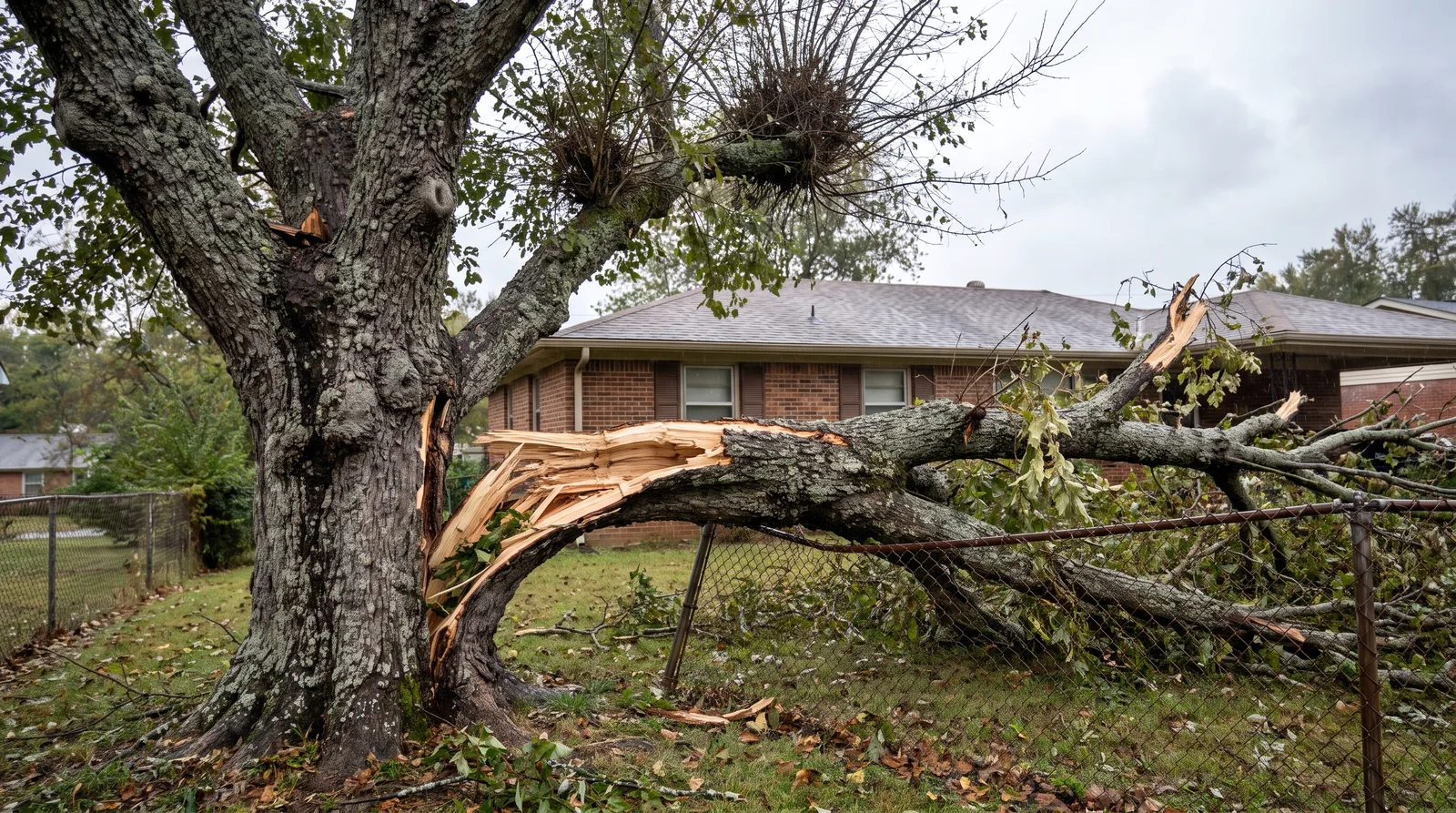
The hackberry — Celtis occidentalis, and its close cousin the sugarberry — is the tree the Central Basin grows when nobody plants anything. Birds spread the seeds, the seedlings tolerate thin limestone soil, drought and shade, and within twenty years there's a 50-foot tree on the fence line that nobody chose. You can tell it by the bark: gray, with distinctive corky, warty ridges that nothing else around here has. The leaves look like an elm's, lopsided at the base, and the small twigs often carry dense clusters of stubby shoots called witches' brooms, which are caused by a mite and a fungus together and are, in themselves, harmless.
Why it fails
Three reasons. First, the wood: hackberry grows fast and the wood is weak and brittle, so long limbs snap under ice, wind or their own weight. Second, the structure: hackberries grown in the open form heavy, spreading limbs with weak attachments, and witches' brooms load the tips. Third, decay: the tree is prone to hollowing at the base and at old wounds, and the warty bark hides it. The result is a tree that drops small dead wood constantly and, once every few years, a live limb the size of a person — and that at 50 to 70 years old often has a trunk you can put your arm into.
What's normal and what isn't
- Normal: witches' brooms in the twigs, nipple galls on the leaves (a harmless insect), small dead branches on the lawn every spring, corky bark.
- Not normal: a hollow or cavity at the base; mushrooms, conks or shelf fungus on the trunk; a crack running down from a fork; a sudden new lean after a wet week; a live limb over a foot thick dropped without a storm.
Keep it or take it down
A structurally sound hackberry with a solid trunk is a perfectly good shade tree, and the right move is to thin the canopy so wind moves through it, remove the deadwood, and reduce the end weight on any limb over the roof — every three or four years. A hackberry with decay at the base or the unions is a removal, because no amount of pruning fixes a hollow trunk, and the failure mode is the whole tree, not a limb. Our arborist sounds the trunk and probes the base before recommending either.
What to plant instead
If a hackberry comes out and you want shade back, plant something that belongs in limestone soil and won't do this to you: chinkapin oak, shumard oak, white oak, blackgum, yellowwood, or a sugar maple if the spot has room. Not a Bradford pear, not a silver maple, and not another hackberry — the birds will handle that for you anyway.
Common questions
Is a hackberry a junk tree?
It's a native, it feeds birds, and a sound one is fine shade. It's just fast, brittle and short-lived by oak standards, and it plants itself where nobody wants it. Judge each one on its trunk, not its reputation.
How do I tell a hackberry from an elm?
Bark. Elm bark is furrowed; hackberry bark has raised corky warts and ridges unlike anything else in a Murfreesboro yard. Hackberry leaves are also rougher and more lopsided, and the small dark berries in fall give it away.
Can a hackberry be cabled?
A big, sound one with a single heavy fork, sometimes. One with decay in the union, no — the wood around the hardware has to be solid.
How much does it cost to remove a hackberry?
Small ones on a fence line, $250 to $700. A big one over the house, rigged down, $1,500 to $4,000; with a crane, $2,500 to $6,500. Hollow ones cost more because they can't be climbed.
Why does my hackberry drop sticky stuff on the car?
Aphids. Hackberries host woolly aphids that produce honeydew, which drips on whatever's parked underneath and grows sooty mold. Annoying, not dangerous; a thinning helps a little.
Related: Hackberry, maple & oak care · Tree trimming · Cabling & bracing · Tree removal